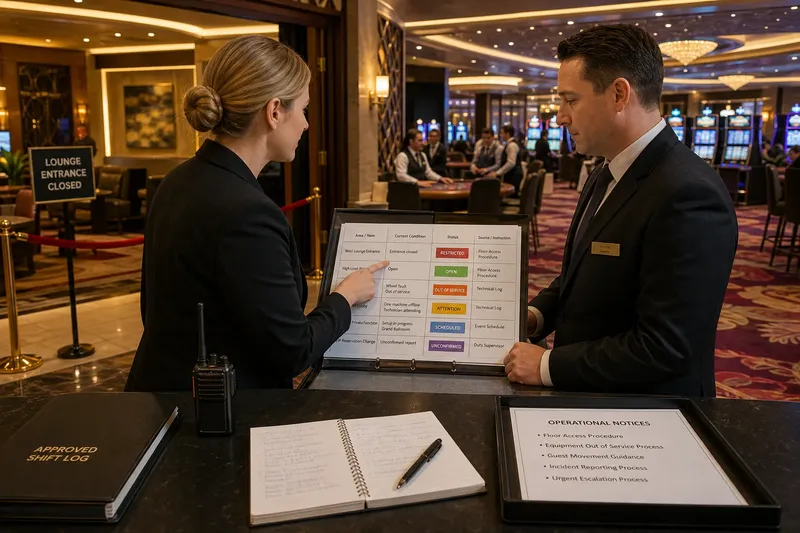
Front Desk or Floor Host: Two Different Service Starting Points
Front desk or floor host support suits different guest needs. Learn how to choose a service point that feels visible, approachable and easy to use.
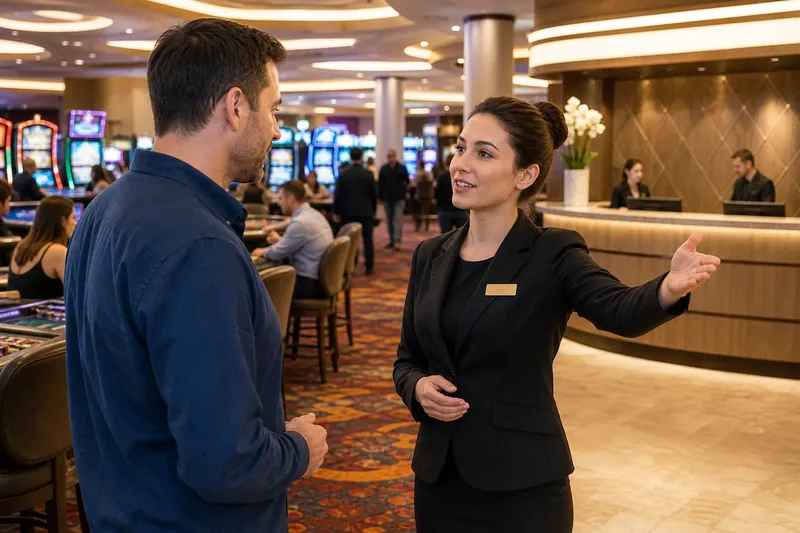
The common mistake with front desk or floor host service is treating them as interchangeable ways to answer a guest. A desk can feel out of reach when someone needs help on the gaming floor, while a roaming host can be hard to identify when a guest wants a clear place to ask.
Both roles support guests, but each offers a different kind of access. A front desk provides a stable, visible destination; a floor host brings help closer to where the guest is. The useful distinction is not which role matters more, but which setting makes it easier for the guest to ask comfortably.
Front desk service depends on a clear destination
A desk works well when guests can find it, understand what it handles and return without having to search again. It can suit enquiries that benefit from a calmer conversation or a fixed point where the guest can ask about available options.
Even a well-staffed desk can be difficult to use if it is obscured by a queue, tucked away near an entrance or labelled in a way that tells guests little. Someone who is already unsure may decide not to ask rather than cross a busy area or risk joining the wrong line.
Walk the route from the entrance, gaming floor and main amenities as a guest might. If the desk is hard to spot, improve its signposting or give staff a simple, precise way to point it out.
A useful direction names both the destination and what the guest can ask there.
Floor hosts make help more immediate
A floor host can offer support where a guest is, which is useful when the guest does not know where to begin or would rather not leave the area. But a person moving through a venue is not automatically easy to approach: guests may mistake a host for security, assume they are occupied or feel unsure about interrupting.
A calm greeting and open posture can make the invitation clearer. A short offer such as “Can I help you find something?” lets the guest accept, decline or explain what they need. If they decline, acknowledge it and give them space.
Notice how a host’s pace, attention and position look from a guest’s point of view. Small adjustments can make availability clearer without making the interaction feel intrusive.
Each setting creates a different service rhythm
At a desk, several guests may arrive together, while calls or colleague questions compete for attention. On the floor, a host may be stopped while already speaking with another guest or moving between areas. The pressure looks different, but in either setting, a guest can feel overlooked if staff do not make their availability clear.
A brief acknowledgement helps set expectations. At a desk, staff might let the next guest know they will be with them shortly. On the floor, a host can explain that they are finishing a conversation before turning to the new request. Keep the wording specific and avoid promising an answer before you know what is involved.
If the request needs another team, say what kind of help is being sought and which service point is appropriate. Guests should not have to guess whether they need to wait, move or start again elsewhere.
Use a simple check to choose the service point
Before directing a guest, consider what they can see, how they want to speak and whether the request is easier to handle in a fixed or nearby setting. These checks help staff choose a suitable starting point without assuming that one role should handle everything.
- Check the guest’s location: If they are already near a visible desk, then offer it as a starting point; if they are across a busy floor, then ask whether a nearby host can assist instead.
- Check whether the guest wants privacy: If they signal that they would prefer a quieter conversation, then suggest an appropriate desk or private area; if they are comfortable where they are, then do not move them unnecessarily.
- Check whether the guest knows where to go: If they can identify the service point, then give a clear direction; if they seem unsure, then show them the route or offer a nearby alternative.
- Check whether the question needs a stable place to return to: If an update may be needed, then explain how the guest can return to the desk; if the request is a simple direction, then a floor host may be enough.
- Check whether a host is already engaged: If the host is helping another guest, then offer the desk or another available colleague; if the host is free, then let them take the request where it arises.
- Check whether the service point can handle the request: If it can, then direct the guest there; if another team is better placed, then explain the appropriate service point rather than sending them on a vague search.
Imagine a guest is standing near a crowded gaming area and asks where to find information about a lounge. In this invented situation, a floor host first checks whether the guest wants directions or a quieter conversation; the guest asks for a quiet place to discuss options. The host then points out the desk and offers to show the route, while explaining that the desk can talk through the available information. The expected result is that the guest knows where to go and why, without being promised that a particular option will suit them.
Which service point fits the guest’s need?
When is a front desk the better starting point?
A front desk can suit a guest who wants a stable place to ask questions, discuss options or return for further information. It is only a practical choice if the guest can identify it and reach it comfortably.
When is a floor host the better starting point?
A floor host may be more convenient when the guest is already on the floor, needs a simple direction or is unsure where to begin. The host can offer help without requiring the guest to search for a counter first.
What if the guest prefers not to approach either service point?
Respect the guest’s preference and avoid pressing them to explain. If they still need assistance, offer a low-pressure option, such as giving a clear direction or letting them know where help is available.
How can staff make the available help easier to recognise?
Use clear signs for the desk and consistent, approachable greetings on the floor. Staff can also describe what each service point handles, so guests are not left to infer its purpose.
Make the service point easy to recognise
Front desk or floor host service works best when the guest can understand where help is available and what sort of conversation each setting suits. A desk offers a fixed destination; a host offers a person nearby. Clear signs, calm greetings and a choice of setting help guests use either one with less uncertainty.
For venue teams, front desk or floor host support is easiest to assess by looking at the guest’s position and preference: can they see the desk, approach a host comfortably, and choose a place that suits the conversation? The answer can guide where staff make help visible and how they describe the service available.